
- Mattuschka and Pucill
- The Yes Men and Bertolt Brecht
- Curating Artists' Cinema
- 52nd Ann Arbor Film Festival
- Large-Scale: Experimental Films
- Joel Ross & Jason Creps
- Joan Jonas & Gina Pane
- Roman Signer
- James Benning: Stemple Pass
- The Ten List: Experimental Cinema
- David Holzman's Diary
- Marina Abramović
- Direct-er's Cuts
- Joan Jonas
- Aurora Picture Show: Big Bad Wolf
- James Benning: El Valley Centro
- Frederick Wiseman's Boxing Gym
- No Failure to Communicate
- Pummeling Through the Frames
- I Want to Have Your Baby
- Grbavica: Land of My Dreams
- Barbara Hammer: A Necessary Presence
- Carolee Schneemann: Color the Shadow
- Stencil Graffiti: Schablone Berlin
- Polish Experimental Films: Hair Snarl
- Lara Odell: Impatient Pixel
- C Schneemann: Imaging Her Erotics
- Anne Charlotte Robertson Interview
- Ilya and Emilia Kabakov
- 0044: Contemporary Irish Artists
- Lynn Cazabon and Delanie Jenkins
- Notes Toward Carolee Schneemann
Schablone Berlin. Tucson: Chax Press, 2005. With Kyle Schlesinger.
Download the Introduction (pdf)
Out of print
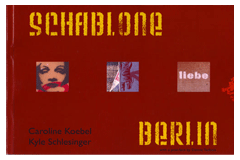
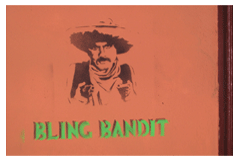
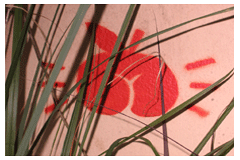
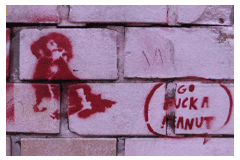
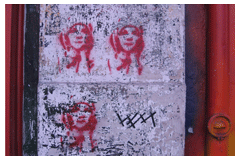
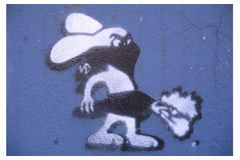
Schablone Berlin is an artists’ book as well as a book of documentation, presenting stencil graffiti from the streets of contemporary Berlin. The book consists of over 100 color photographs showing not only the graffiti, but also its placement within the confines of Germany’s most international metropolis. The introduction examines the semiotic and performative aspects of stencils within the contexts of art history, media, and urban anthropology.
This art and text project by Caroline Koebel and Kyle Schlesinger is a loving drift through the streets of Berlin to examine and to be inspired by its raw, lively, lustful, sometimes esoteric stencil culture. Exquisitely photographed, this work plays in the in-betweens of poetics and politics, the trivial and the insightful, the amusing and the disturbing, the immediate and the aloof. One way or another, this book will seduce you.— Critical Art Ensemble
Contemporary trackers on the trail of an esoteric species, Koebel and Schlesinger have captured a gallery of transitory signs from the surface of Berlin's walls. The very sign of urbanism, these swiftly made images depend on a community of knowing readers to recognize their codes, nod, and signal back across the space of time and geography. The city is the site, scene, of a whole system of traces and communications. The marks show their ephemerality and questionable legality in the very stealth mode of their production. Stencilled, spray painted, rapidly produced, they haunt the walls with their fading imagery, semaphore signals in a common but still-specialized system, introducing their alternative image-speak into the regulated zones of public discourse. A beautiful collection, thoughtfully framed by its introduction.— Johanna Drucker
One of my favorite books I've read this year is Schablone Berlin, which for some odd reason Amazon is storing under the title Berlin Schablone; I hope people continue to seek it out and find it, a fantastic candybox of images and speculation. It's very user friendly and you hardly have to know a thing about Germany or the German language to understand it. Caroline Koebel and Kyle Schlesinger are admirable guides, pointing out a set of signs which we might never even have noticed in the busy citiscape of modern Berlin. Maybe you have to be there and be intimate with the city before you notice its "Schablone," i.e. the stencils that graffiti artists and other activists have plastered over every conceivable public surface, whether it be the curbs beneath the fire hydrants, or the diagonal juts of the fire escapes. You don't even notice them at first, and then, like every other living thing, they become inescapable.
The photographs themselves are lovely: lucid, clear-eyed, deliberately rendered and printed in small, postcard sized images. (Well, large postcards.) And the variety of stencilling is staggering. Every conceivable artist is invoked, from the gabby, petalled overpainting of Raymond Pettibon to the UFA pristinity of Cocteau: if he (or she) can be reduced to a few lines and shadows, then a stencil can be made and reproduced, within a few seconds, on the streets of any city. Why does Berlin have so many? Our guides have a theory or two to explain it. In turn the stencils force us to look again at the public buildings and structures they decorate or détourne: the sad magentas and river blues of Berlin are themselves totally hallucinatory. You could be nowhere else, Kudos to Tucson's Chax Press for bringing us this strange bewitching treat.—Kevin Killian
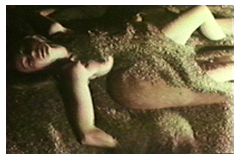
Hair Snarl: the Aesthetic Body in the Order of Things
Film essay published in The Brooklyn Rail in March 2004
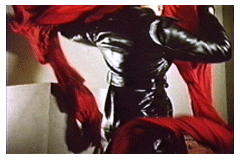
A traveling program curated by Warsaw-based Lukasz Ronduda of short works from the Archive of Polish Experimental Film, “Polish Women Artists Films of the 1970s and ’80s” was first presented in April 2003 at The Kitchen, and subsequently in October at Hallwalls in Buffalo. The program will screen again in summer 2004 at the Tate Modern. But rather than surveying “Polish Women Artists Films of the ’70s and ’80s” as a whole, I want to look closely at how the films of three of the artist-filmmakers, Zofia Kulik, Ewa Partum, and Teresa Tyszkiewicz, offer particular insight into an international dialogue about the possibilities of the body in art during these two decades. Personally influenced in my own creative practice by such vanguard artists as Theresa Hak Kyung Cha, Valie Export, Eva Hesse, Adrian Piper, and Carolee Schneemann, it is with great enthusiasm that I come to know the Polish artists whose work in many ways resonates with theirs. The vital output of these women artists from twenty, thirty, or more years ago regarding the investigation into how the body marked by sexual difference produces and deconstructs meaning and language systems comprises art historical turf wars largely responsible for the— in some cases— thriving careers and— in others— tenacity despite obscurity of contemporary artists addressing similar concerns.
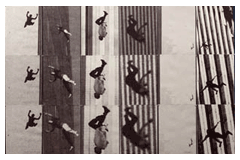
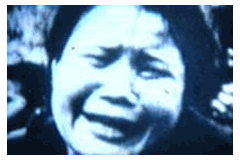
Color the Shadow
Catalog essay in Carolee Schneemann: Split Decision, edited by David Liss and Photios Giovanis. Buffalo and Toronto: CEPA Gallery and the Museum of Contemporary Canadian Art, 2007.
Purchase this book from CEPA Gallery
Color the Shadow is third in my series of critical writings about legendary multidisciplinary artist Carolee Schneemann. Having focused previously in an article for Wide Angle on her revolutionary film Fuses, in the new writing I examine the film Viet-Flakes: 1) as a poetic outcry against the Vietnam War, 2) in the context of the artist’s body of work, and 3) as an instrument by which to comprehend mass media and artistic expression in the contemporary context of Iraq.
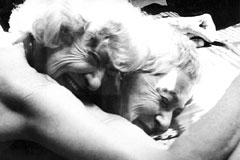
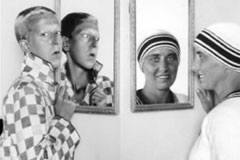
Barbara Hammer: A Necessary Presence
Catalog essay printed in English with Spanish translation, Festival Internacional de Cine Lésbico y Gai de Madrid / Madrid's International Lesbian and Gay Film Festival, Madrid, Spain, 2008.
Barbara Hammer: A Necessary Presence is an introductory essay to the work of legendary avant-garde lesbian filmmaker Barbara Hammer. It accompanies her 2008 retrospective at Festival Internacional de cine lésbico y gai de Madrid, including the films Lover Other, Dyketactics, Double Strength, Nitrate Kisses, History Lessons, and Tender Fictions.
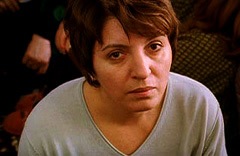
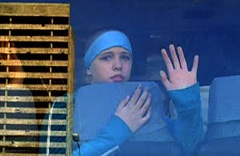
Torture, Maternity, Truth in Jasmila Zbanic’s Grbavica: Land of My Dreams
Essay published in Jump Cut: A Review of Contemporary Media, edited by John Hess, Chuck Kleinhans, and Julie Lesage, No. 51, Spring 2009.
Set in Sarajevo a decade after the war in Bosnia and Herzegovina, Grbavica: Land of My Dreams plumbs the depths of a single mother's relationship with her daughter.
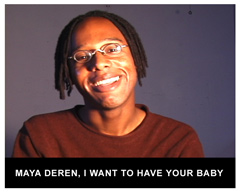
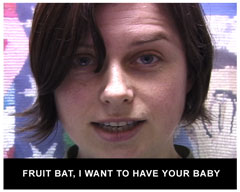
I Want to Have Your Baby
Artist's statement published in "Experiments in Documentary," guest edited by Lucas Hildebrand and Lynne Sachs, Millennium Film Journal No. 51, Spring-Summer 2009, pp. 92-95.
Order issue at Millennium Film Journal online
In the collective performance action I Want to Have Your Baby (2003-2005) over 300 participants in sites including Los Angeles, Budapest, Havana, Berlin, Buffalo, and London conceived hypothetical offspring in a digital repopulating of the world with humane beings.
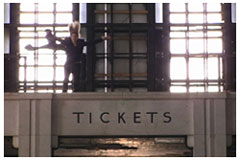
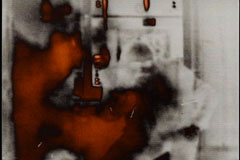
Pummeling Through the Frames: A Conversation with Caroline Koebel
Interview by Bernie Roddy in Afterimage: The Journal of Media Arts and Cultural Criticism, Vol. 37 No. 4, January-February 2010, pp. 10-14.
Order issue at Afterimage online
The interview explores questions raised by the films presented at the University of Oklahoma in Norman in April 2009. The titles are Berlin Warszawa Express, ReAction: "From the Portfolio of Doggedness," hole or space, Grand Central/Central Terminal, Repeat Photography and the Albedo Effect, Sunroof (Benazir Bhutto Assassination), All the House (Haditha Massacre).
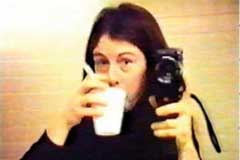
Anne Charlotte Robertson Interview
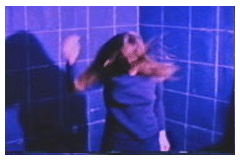
On November 11, 2001 I interviewed Anne Charlotte Robertson by telephone in anticipation of her upcoming NEA-funded residency at Squeaky Wheel in Buffalo, New York. Now in 2010 I am making the original (long) version as well as the published (condensed) version available here.
After a quarter century of filmmaking, Anne Charlotte Robertson has thirty titles to her name—thirty titles, that is, outside her film diary. Begun in 1981, the diary is thirty-eight hours and, as Robertson says, "just continues." The small gauge—mainly Super 8—films are the fruits of a fiercely independent process; the filmmaker admits to having used a crew "only once" while in art school and has "asked someone to hold the camera maybe four or five times."
No wonder, given the autobiographical nature of the work, that Robertson herself plays all roles of production. Previewing titles on her compilation videotape, ranging from Snooze Alarm (1979) to Melon Patches (1998), it becomes clear that the more exclusively—and obsessively—about Robertson, the more riveting the film. When I raised this point in a phone interview, she replied that especially in her early work, making films was a form of self therapy, a means to stop various cycles of self-destruction. For example, the frenetic Magazine Mouth (1983)—featuring animated pictures of Robertson, eyes bulging, said orifice wide open and entryway into her 'body-self' for all kinds of crap,—"got [her] out of the cycle of binging."
Caroline Koebel, "Anne Charlotte Robertson Interview," Artvoice (Nov 15, 2001)
Imaging Her Erotics: Carolee Schneemann
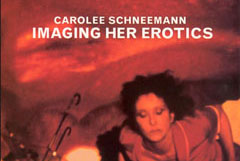
Book and exhibition review--Carolee Schneemann, Imaging Her Erotics: Essays, Interviews, Projects (MIT Press, 2002) and Carolee Schneemann: Embodied at P.P.O.W. Gallery (Winter, 2002)--published in The Brooklyn Rail in Early Summer 2002
September 2001, amidst 9/11 fallout, Carolee Schneemann came to Buffalo, New York (where I live) as part of a visiting speaker's series at the University of Buffalo. Ghen Zando-Dennis programmed a supplementary evening of films, which included the rarely screened Kitch's Last Meal (1973-76). This double-projection Super 8 film is an early incarnation of the performance Interior Scroll (1975). The performance's text comes from the film's soundtrack: a vituperative exchange between Schneemann and a male structuralist filmmaker (to be disclosed later as theorist Annette Michelson). Whereas Interior Scroll, in which the artist uncoils and reads aloud a tightly folded paper from her vagina, has become Schneemann's most iconic work, Kitch's Last Meal remains relatively unknown.

No Failure to Communicate
Interview by Marc Savlov in The Austin Chronicle, April 23, 2010
The interview covers extensive ground in conjunction with a solo screening at The Austin Film Society in April, 2010.
Body and Soul: Frederick Wiseman's Boxing Gym
Film review in The Brooklyn Rail, June 2011
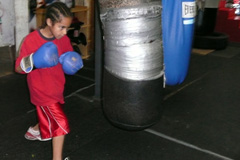
Frederick Wiseman's Boxing Gym focuses the director's trademark observational eye on Lord's Gym in Austin, Texas. The gym, managed and co-owned by Richard Lord (with his wife Lori), bespeaks American Pluralism in the ideal, with its own organs, causality, language, and belief structure. Lord's stands in stark relief from the ordinary life beyond its doors, though it nevertheless scrapes against outside circumstances and events at key uncanny intervals in the film, moments that Wiseman captures with an engrossing authorial voice and a sense of the gym's inescapable rhythm.
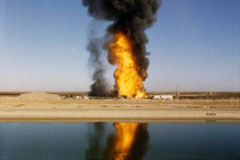
James Benning's El Valley Centro
Film review in …might be good, Issue #188, The Return Of The Really Really Realest Real, April 20, 2012.
Comprised of 35 two and a half minute shots, James Benning's 16mm experimental documentary El Valley Centro (2000) presents a curious taxonomy of California's Great Central Valley. In the process it frames a tug-of-war between the land and the uses humans find for it: natural wonders—and their demise into wasteland, agribusiness and corporate cattle ranching, tract housing and anti-drug billboards ("where meth goes violence follows"), water, nuke and wind energy. This is a place where some people are and others are not, but the geography imaged here is the singular vision of one visitor to the region.
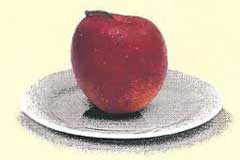
Ilya and Emilia Kabakov's "20 Ways to Get an Apple Listening to the Music of Mozart"
Exhibition review in Art Papers, July-August 2001, pp. 50-51.
Upon entering Ilya and Emilia Kabakov's "20 Ways to Get an Apple Listening to the Music of Mozart" (Columbus Museum of Art, February 1-June 10), the viewer is immediately struck by a sensation of lightness. A room within a room, the outer limits of the installation are a series of white walls comprised of flowing fabric. The space is enveloping. At first there do not appear to be any sharp angles. There is a precursory unboundedness contradicted once the viewer advances into its midst. Accentuating the pull between airiness and enclosure is, in the artists' words, "the music of Mozart, one of his piano pieces, light and transparent...."
Lara Odell's "Impatient Pixel"
Exhibition review in Art Papers, September-October 2002, p. 42.
Lara Odell's "Impatient Pixel"(Big Orbit Gallery, May 4-June 23) features an impressive body of work produced over the course of a single compact year. One Feet Deep (2001-2002) is a series of nine iris prints of swimming pools. Odell is from the West Coast. Imagine the pool for a SoCal artist: lots of aqua blue water and signs of life--namely white people tanning themselves on Day-Glo rafts or chaise lounges. The artist would subvert this tired image--making it into a mockery of the American Dream and the culture of escape. The pictures here however come out of the specificities of a very different place: Buffalo, New York, where Odell has been based for the past four years. Buffalo is for many synonymous with snow. Other associations are decline and loss--of the region's economy, of its populace--a forgotten loneliness. For its residents, the city often feels empty, a sensation confirmed by explaining each time friends come through that the question "but where are all the people?" is a constant and therefore rhetorical one. "The people" are not here--although we are here and sometimes we do make ourselves brilliantly visible.
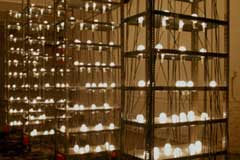
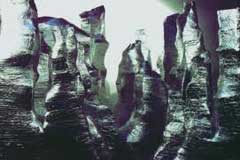
"0044: Contemporary Irish Artists in Britain"
Exhibition review in Art Papers, March-April 2000, pp. 42-43.
Organized by the Crawford Municipal Art Gallery, Cork, Ireland, the traveling exhibition 0044: Contemporary Irish Artists in Britain (Albright-Knox Art Gallery, September 18-October 31) contained curious postmodern projects by Daphne Wright, Frances Hegarty and Andrew Kearney--truly hybrid creations of light, sound, matter, image and the physiotemporal manipulations of a complete space. Drawing from conceptualisim (in their close wedding of product to concept), the three productions seem neither dated nor contemporary. This fuzziness could be attributed to the trend across the arts to re-appraise forms, movements and artists from past decades, especially the 1970s.
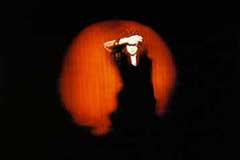
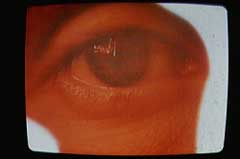
Lynn Cazabon: Spot and Delanie Jenkins: Root Bound
Exhibition review of installations at the Mattress Factory in Dialogue, September-October 1999, p. 31.
Descending in the elevator. Rounding the corner. Approaching the entrance of the windowless underground space. A certain something becoming ever stronger....
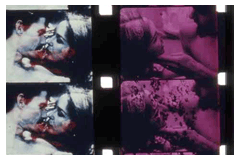
From Danger to Ascendancy: Notes Toward Carolee Schneemann
Essay in Wide Angle, Volume 20, Number 1, January 1998, pp. 50-57.
Recently, spending several uninterrupted days in bed with the flu, I became increasingly absorbed by thoughts that, through their randomness and disconnected quality, seemed more revelatory and meaningful than those of my life of action.
In 1967, when I was just being born, Carolee Schneemann completed Fuses, a film about the erotic exchange between the artist and her long-time lover, the composer James Tenney. In its referential, indeterminate space, Fuses is akin to my sickbed. Says the filmmaker a quarter century later, "I wanted to see if the experience of what I saw would have any correspondence to what I felt--the intimacy of lovemaking."
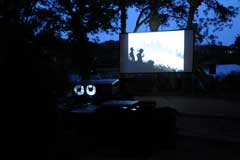
Aurora Picture Show: Big Bad Wolf
Review of film program curated by Mary Magsamen of Aurora Picture Show including titles by Lotte Reiniger, Lynne Sachs and Eileen Maxson in …might be good, Issue #190, My Parrot Can Talk, Can Your Honor Student Fly?, May 18, 2012
If the folk tale ranges over generations first orally and then beginning in the 17th c. with the advent of the fairy tale as a literary genre, key to its very being is its contingency upon each "author" and that teller's positioning in place and time (or history). In devising innovative forms by which to tell tales, both familiar and novel, the titles included in Aurora Picture Show's program Big Bad Wolf invoke this centuries-old performative spirit so imbued with a sense of the need to create in order to re-create.
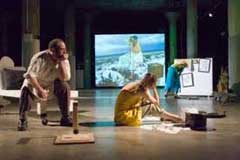
Joan Jonas: The Shape, The Scent, The Feel of Things
Review of multimedia performance by Joan Jonas in Art Papers, July/August 2012
The inception of The Shape, The Scent, The Feel of Things is striking: On a Southwest trip some forty years back, Joan Jonas witnessed the Hopi snake dance, a memory given new life in the early 2000s when she read a reference to the dance by the German art historian Aby Warburg. Years lapsed between Warburg's time with the Hopi in the late 1800s and his writing in 1924 about their dances and rituals. As Jonas later wrote, he was then "recovering from a mental breakdown," his eassy acting "as a cure, or proof of one, to himself as much as to his physicians."

Direct-er's Cuts
Review of film program curated by Steve Cossman of Mono No Aware including titles by Cossman, Len Lye, Jodie Mack, Eric Stewart, Douglas Urbank, Devon Damonte, Aaron Vinton, and Joshua Lewis in …might be good, Issue #195, Hold the Phones!, July 27, 2012.
Direct-er's Cuts, a touring 16mm film program curated and including work by Steve Cossman, centers around a clear organizing principle: the artist averts the camera's dominion in the filmmaking process by exploring—and exhausting—all other means by which films might come into being.
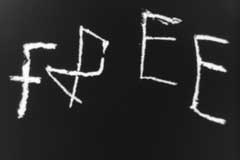
One historical work anchors the otherwise contemporary program: Free Radicals (1958/1979) by Len Lye, the New Zealand-born pioneer of direct film. To make Free Radicals, Lye scratched the film emulsion, resulting in a microcosm of negative and positive space and polyphonic visual rhythm that together with a soundtrack of music by the Bagirmi tribe of Africa sculpts a transfixing experience. His actions exist in a time-space continuum evoking our cave-dwelling ancestors and extra-terrestrial communications. The simplicity of his ingenuity remains a beautiful thing.
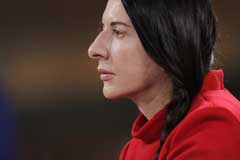
Marina Abramović: The Artist is Present
Film review in Glasstire, August 31, 2012.
Director Matthew Akers screened Marina Abramović: The Artist Is Present (2012) before a packed house during his Austin stay as a Texas Filmmakers' Production Fund juror. While detailing the internationally acclaimed Yugoslav-born (1946) artist's past, the HBO documentary charts not only the time leading up to the eponymous retrospective exhibition and new performance in 2010 at MoMA but also the three-month run of the show, which in addition to photographs, videos and artifacts encompassed reenactments of solo and collaborative works performed by thirty artists chosen and trained by Abramović.
Ulay, Abramović's partner in love, life and art for a twelve-year period ending roughly twenty years prior to the documentary's making, recounts encountering her on their shared birthday (November 30) in Amsterdam in 1975. He says, "I cared for the wounds"—those resulting from her auto-destructive performance (for which she carved a star into her abdomen and whipped herself).
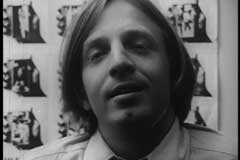
David Holzman's Diary
Film review in Glasstire, September 18, 2012.
David Holzman (L.M. Kit Carson), the protagonist and "filmmaker" of Jim McBride's David Holzman's Diary (1967), is nestled in his West 71st Street apartment between movie posters and art reproductions, windows and mirrors, Eclair 16mm movie camera and Nagra sound recorder. In a mode of direct address he confesses to us—his absent yet implied future witnesses—that he's 1) lost his job and 2) received an A-1 classification ("perfectly American") from the draft board. Such is the context on this day—July 14, 1967—of his decision to initiate a film diary.
In an affected Irish accent not repeated elsewhere, Holzman cajoles, "bring yourself into focus…expose yourself to yourself" and quotes Jean-Luc Godard, "film is truth 24-times-a-second." Given our knowledge that McBride actually is the filmmaker, we glean that "cinema truth" is already under scrutiny.
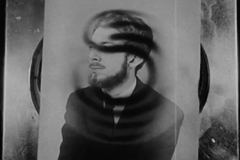
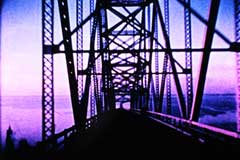
The Ten List: 25 Years of American Experimental Cinema (1953-1978)
Writing in OtherZine Issue 24 : Spring 2013 on film marvels by Rudy Burckhardt, Shirley Clarke, Kenneth Anger, Barbara Rubin, Carolee Schneemann, Tom Chomont, Hollis Frampton, Paul Sharits, Bruce Conner, and Barbara Hammer
Each of these avant-garde films is so complete in its inimitable cinematic reality that the scope of experience proffered collectively by them is beyond description. Made decades ago, they teem with new life as the context of their viewing continuously evolves: retaining their relevance and resonance. Fortunately, many of them have been preserved and restored in recent years by such entities as the National Film Preservation Foundation, Anthology Film Archives, UCLA Film & Television Archive, and the Museum of Modern Art. Prints are available for rental and purchase through such groups as Film-Makersʼ Cooperative and MoMA Circulating Film Library in NYC and Canyon Cinema in San Francisco. In addition digital versions circulate online both officially and informally, and there are DVDs for purchase of collected works by several of the artists.
Decoding the Unabomber: Stemple Pass by James Benning
Film review in Glasstire, April 18, 2013.
Squirrel fetus stew anyone? Homemade pipe bombs to destroy the "technical class?" Smashing windows as an initiation into homicidal mania? Pus-filled gums resulting from porcupine meat lodged at the base of a tooth after an especially chewy repast?
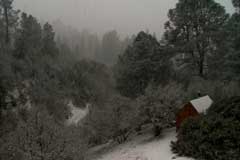
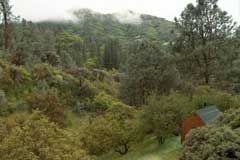
The story presented by James Benning in his film Stemple Pass of the solitary existence, profound and prophetic writings, and sociopathic acts of Theodore J. Kaczynski (the "Unabomber") is nothing if not engrossing and enlightening. In an invigorating Q&A led by Richard Linklater at a recent Austin Film Society screening, Benning's film unearthed serious questions about technology, humanity and the natural world, environmentalism, and teaching and tactics disruptive of the rise of machine culture.
Three Works by Roman Signer at Rice U's Video Cubicle
Exhibition review in Glasstire, May 29, 2013.
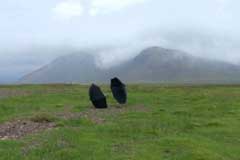
With a combined running time of under six minutes, Roman Signer's three-video loop at Rice University's new RG cubicle video space is perfect for anyone seeking exposure to the international art scene during a busy day in central Houston. Visiting a friend in the Museum District, my sudden proximity to this Swiss artist's works, which I had known only from afar (he exhibits rarely in the US) was serendipitous. I shut the door, hid the key under the flowerpot and engaged the radical (for Houston) act of walking—helicopters overhead on their way to and from the nearby medical center—until I reached the cubicle.
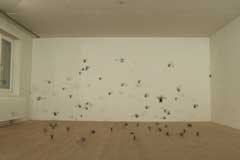
56 Kleine Helikopter (56 Small Helicopters), 2008, is, at 3 minutes 10 seconds, the longest video. A single, wide static shot documents the "action" (Signer's chosen term for his projects) transpiring at one end of a nondescript white room whose uniformity is disrupted only by a window on one side. Miniature flying machines (toy-sized helicopters) stand on the floor in eight columns. The configuration's military order is quickly replaced by the 'copters' chaotic mass ascendence. All hell breaks lose.
Parallel Practices: Joan Jonas & Gina Pane
Exhibition review in Glasstire, June 8, 2013.
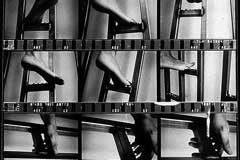
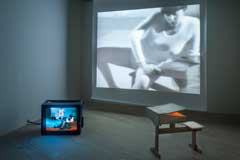
According to exhibition literature, Parallel Practices: Joan Jonas & Gina Pane at the Contemporary Arts Museum Houston (CAMH) "celebrates the shared and complementary aspects of Jonas' and Pane's art, and highlights the differences that characterize their unique bodies of work." The artists share being females of the same generation, working against the grain of the patriarchal art establishment, and using themselves and their bodies as inception, means and end to art production. They also range freely amongst artistic mediums and combinations thereof, presaging contemporary artists' obsession with "inter-" and "transdisciplinarity." Their differences are too multifold to investigate here in full; that said, Jonas and Pane are at especial odds in terms of bodily subjection to pain. Pane's practice revels in an active masochism.
How to Cure World Blindness: An Interview with Joel Ross & Jason Creps
Interview in Glasstire, June 8, 2013.
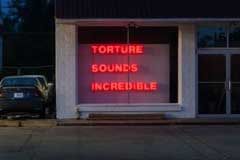
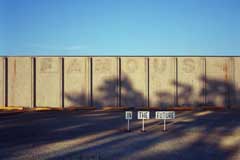
JR & JC: All of us are interacting on a daily basis on so many platforms with language as visual stuff—words as shapes and colors, with or without photos or illustrations attached and, of course, containing all manner of ideas and pitches in advertising. It is a dynamic space for us to conduct our own experiments.
We like the idea of putting language out there as voices in the landscape. They're sort of portraits but, if they function the way we intend for them to, they say more about the viewer than about the narrator or about us. We're aware that the works operate as a mirror, and we play with language to allow the mirror to function. The viewers bring their sense of themselves and their role in everything to the experience of encountering this sign in this location at this moment. Their reading of it depends on what they see in that reflection. They almost accidentally reveal themselves.
Large-Scale: Experimental Films on 35mm
Film program review in Glasstire, July 19, 2013.
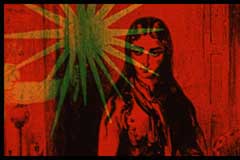
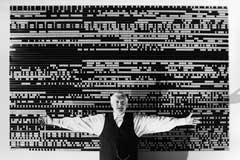
Large-Scale: Experimental Films on 35mm at Austin's Alamo Drafthouse Ritz theater featured classic and contemporary cinema. No film acted as a window on the world; each film claimed itself—its space—as a way to engage the state of being alive, a way of living in the world. Productions ranged from 1960 through 2011—that's 51 years of film art—with the older films rivaling the recent in their impact.
Screenings of artists' noncommercial cinema in digital form are rare enough. Showings of experimental film on 35mm are veritably unheard of. Not many artists have produced work on this more expensive format in the first place (as compared to 16mm and video) and the logistics of presenting 35mm shorts is daunting. For those in attendance at the Alamo Drafthouse Ritz on June 1, a sunny Saturday afternoon in Austin, Large-Scale was an experience like no other.
52nd Ann Arbor Film Festival
Film festival review in Millennium Film Journal No. 60 / Fundamentals / Fall 2014.
Purchase Issue No. 60 at MFJ Online
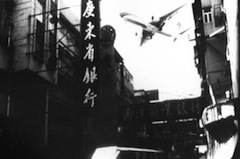
Self-knowledge and decision-making are tools necessarily sharpened by the challenges of the 52nd Ann Arbor Film Festival. Goals must be set and pathways configured and reconfigured according to the accrual of information and the play of desire. I chose Steve Anker's juror presentation, Big as Life, 8mm Experimental Film in the U.S.: The Boston Underground, 1976-1992 for my port of entry because of the late Anne Charlotte Robertson (1949-2012).
Curating Artists' Cinema
Essay in Un-Dependently Yours: Imagining a World Beyond the Red Carpet (Experiments in Cinema Yearbook 2015). Eds: Bryan Konefsky, River Quane, Michelle Mellor. Albuquerque: Basement Films, 2015.
Purchase book at Experiments in Cinema
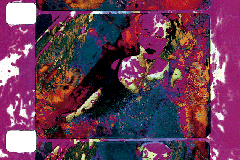
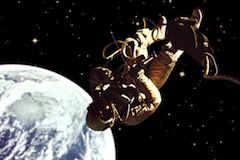
As a maker of experimental film and artists' video, I am keenly aware of the contemporaneous need for the making of context and community, for creating the (meta-) conditions of the work's existence beyond the source of origin, its contemplation by others. "Audience" as an abstract concept is a fount of desire, integral to critical and aesthetic process, and the basis of a dialogical ontology of filmmaking.
In their devotion both to filmmaking and disseminating radical film art culture, American avant-garde mavericks Maya Deren and Jonas Mekas inspire next generations also to simultaneously make and curate. Gen Xers such as me find a home in cinema-as-counter-hegemonic-expressive-form after being weaned on punk and hardcore music subcultures. Such currents of influence exude DIY and DIWO ethos, the very spirit that sparks today's most vital actions in global artists' cinema.

'The Yes Men Are Revolting' and Bertolt Brecht
Movie review and art criticism experiment in OtherZine Issue #29: KINO-EYE / September 2015.
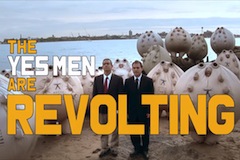
Two months after watching 'The Yes Men Are Revolting' (Directed by Laura Nix and The Yes Men, 2015, 91 mins.) together at the local cinema in Columbus, Ohio, I interviewed the five others in my group about their recollections of the shared experience.
The following is a text relaying between our Yes Men conversations and Bertolt Brecht's thoughts on the potential of art to make the familiar strange and, thereby, to change the world for the better as exemplified by his theory of the A-Effect (aka Alienation Effect and Verfremdungseffekt). Ultimately, this movie review and art criticism experiment was fomented by the reality of my being deep in the throes of preparing to teach Brecht's A-Effect to graduate students when I happened to see the new documentary and realized the radical ties that The Yes Men have to Brecht.
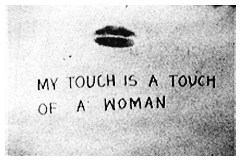
Mattuschka and Pucill: These Films Cannot Be Proved
Essay on European film artists Mara Mattuschka and Sara Pucill in OEI No. 69-70: On Film. Eds: Martin Grennberger and Daniel A. Swarthnas. Stockholm: OEI, 2015.
Purchase OEI No. 69-70: On Film
More info at Experimental Cinema
OEI #69–70: On Film is 496 pages (edited by Martin Grennberger and Daniel A. Swarthnas) on experimental film from Leo Reis, Åke Karlung, Gunvor Nelson, Claes Söderquist, Carl Slättne, Sven Elfström, Hans Nordenström, Sture Johannesson & Jørgen Nash, Jan Bark, Bo Jonsson, Olle Hedman and Ronald Nameth to Rose Lowder, Abigail Child, Cécile Fontaine, Frédérique Devaux, Barbara Hammer, Raymonde Carasco, Lynne Sachs, Sandra Davis, Caroline Koebel, Barbara Rose, Adeena Mey, Ute Aurand, Peter Gidal, Peter Hutton, Nicky Hamlyn, Robert Beavers, Bruce McClure, Guy Sherwin, Pavle Levi, Ernie Gehr, Pier Paolo Pasolini, Alberto Grifi, Carmelo Bene, Jean-Marie Straub, Peter Nestler, Hartmut Bitomsky, Emilie Vergé, Nicole Brenez, Jean Painlevé, Fernand Deligny, Alain-Alcide Sudre, Dominique Noguez, Carole Contant & Éric Thouvenel, Henry Hills, Frank Kuenstler, Jean-François Lyotard, Kim West, Elke Marhöfer, Teddy Hultberg, Martin Grennberger, Daniel A. Swarthnas, Anders Karlin, Stefan Ramstedt, John Sundholm, Lars Gustaf Andersson, Bengt af Klintberg, Mika Taanila, Jonas Mekas, Jørgen Leth, Carl Henrik Svenstedt, Alexander de Cuveland, Lina Selander & Oscar Mangione, Dan Lageryd, Marion Naccache, Anna Ådahl, John Skoog, Tris Vonna-Michell, Rosa Barba.
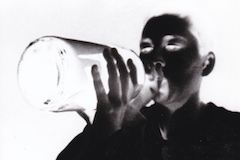
Early 1990s NYC was fertile ground for a young experimental filmmaker just out of college in terms of both the diverse local no-budget cinema and the spirited works finding their way across the Atlantic from such artists' organizations as sixpackfilm in Vienna and London Filmmakers' Co-op. Mara Mattuschka and Sarah Pucill in particular challenged - and inspired - me and my peers on the moving image border as formidable European artists sowing vast labor for the female sexuality and aesthetics collective research bank.
Mattuschka's Pascal-Gödel (1986, 16mm, b/w, silent, 5 min) and Pucill's Mirrored Measure (1996, 16mm, b/w, sound, 10 min) are each a cocoon encasing a singular inwardly referencing cinematic world, and each a communicative act affirming a passage outward from the profilmic to the viewer. While there is a tempting delirium to getting lost within, there is likewise a provocative dare to hold one's ground and keep one's wits from outside the respective diegetic scope. Like the theorems of the mathematicians (after whom Mattuschka names her film) Blaise Pascal and Kurt Gödel, there is a certain undecidability, incompleteness, and self-prophesying riddling these films whose muscles as experiments in cinema ripple.