
- Kino B: Berlin-based Artists
- The Friendship State
- ERC: Kelly Sears
- Avant Cinema: FMC
- Avant Cinema: Chick Strand Tribute
- Film-Makers’ Cooperative Benefit
- April Thursdays of Experimental Film
- Forum on Torture
- The Inventing Space of Cinema
- Writers Making Film
- Examinants
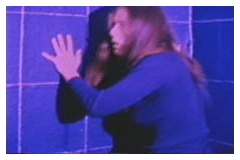
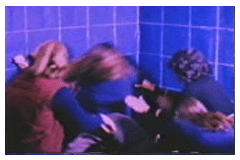
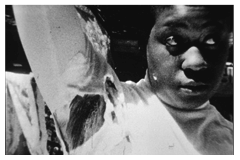
Images: Locomotion by Anne Charlotte Robertson
Examinants
One-hour program guest curated for Concrete Stream at University of Maryland, Baltimore County in 2002 featuring performative videos and films that confound relations between subject and object. Akin to how examination means both "the act or process of examining" AND "the state of being examined," examinant refers to both the examiner AND the examinee. The examinant conducts research on a subject AND is also the subject of analysis. These artists subvert clear distinctions between the active examiner and the passive subject of examination by offering examples of how both roles can be at stake simultaneously.
Lara Odell & Monica Duncan: Antibodies
Caz Mcintee: Ms. Maverick
Nao Bustamante: Sans Gravity
Simone Jones Mobility Machines: Air And Water
Laura Nix: Performance #3
Haralez (Elizabeth Monoian & Suzie Silver): Untitled No. 1
Anne Charlotte Robertson: Locomotion
Anya Lewin: Bear Dreams
Rachel Stevens: Nostalgia Translation: San Francesco, San Francisco, St. Francis
Nao Bustamante (With Miguel Calderon): The Chain South
Program presented at UMBC and netcast on Dec 5, 2002. I also presented Examinants in person at Instituto Superior de Arte de La Habana, Havana, Cuba, Nov 28 - Dec 1, 2002.
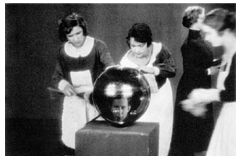
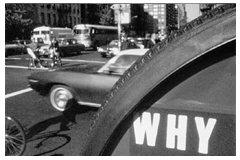
Images: Seashell & the Clergyman by Germaine Dulac, Zorns Lemma by Hollis Frampton
Writers Making Film
Screening series questioning how different forms of writing—screen and page—act on and in relation to one another. The films in the series are by makers either known primarily as writers or whose theoretical and poetic writings are integral to their filmmaking.
Films by Hollis Frampton, Feb 27, 2002Zorns Lemma, Lemon, Less
Films & Poetry by Abigail Child, Oct 2, 2003
Mayhem, Dark Dark
Keith Sanborn Presents Situationist films by Guy Debord, Feb 11, 2004
Society of the Spectacle and Refutation of All the Judgements, Pro or Con, Thus Far Rendered on the Film "The Society of the Spectacle"
Jean Genet, Germaine Dulac & Antonin Artaud, Mar 24, 2004
Un Chant D'Amour by Jean Genet and The Seashell and the Clergyman by Germaine Dulac and Antonin Artaud
Poster: Arzu Ozkal and Orkan Telhan
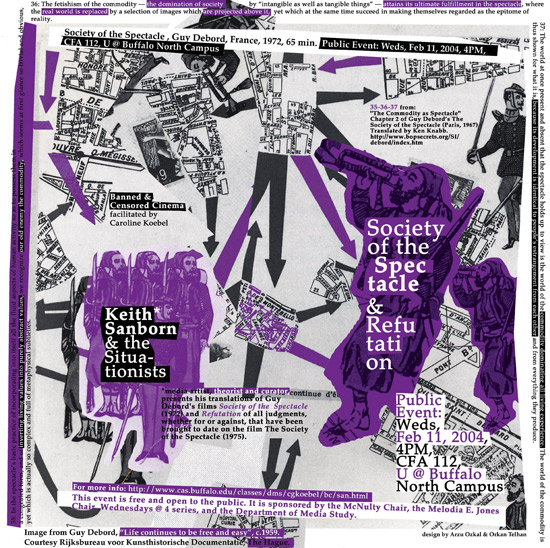
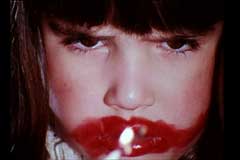
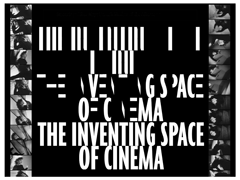
Images: Jennifer, Where Are You? by Leslie Thornton, Poster by Kyle Schlesinger
The Inventing Space of Cinema
Joyce Wieland: 1933 (1967)Lana Lin Through the Door (1992)
Barbara Hammer: Pools (1981)
Janie Geiser Terrace 49 (2004)
Leslie Thornton: Jennifer, Where are You? (1981)
Storm De Hirsch: Peyote Queen (1965)
Babette Mangolte: There? Where? (1979)
Marie Menken: Moonplay (1962)
Marjorie Keller: Six Windows (1979)
Maya Deren and Alexander Hammid: Meshes of the Afternoon (1943)
Maya Deren’s first film experiment Meshes of the Afternoon (1943) ignited the American avant-garde film movement at mid-century, and for decades now has been screened continuously in cinema studies classrooms. At one point the film’s protagonist (played by Deren) strides in a space that only cinema makes possible: close-ups show the woman’s alternating feet against sand, grass, pavement, and rug, creating the effect that she actually exists simultaneously in these ordinarily disjointed environs.
Of this sequence, Deren has written, “It was like a crack letting the light of another world gleam through. I kept saying to myself, ‘The walls of this room are solid except right there…There’s a door...I’ve got to get it open because through there I can go to someplace instead of leaving here by the same way that I came in.’” ("A Letter to James Card," 1955, reprinted in Essential Deren, 2005)
In a like-spirited displacement, The Inventing Space of Cinema re-posits Meshes of the Afternoon within a frame of works—including live action, animation, and re-purposed footage—that use experimental means and investigatory techniques to pose questions about objective and subjective space, gendered spatiality, and filmic architectonics. The frame is intended to open a necessary entrance to Meshes, one enabling the pre-canon film’s flux and indeterminacy to sneak past into the present.
Film screening and discussion on March 1, 2006, at the University at Buffalo. Respondents: Thom Donovan, Meg Knowles, Vincenzo Mistretta, & Carolyn Tennant
Re-presented in NYC on February 25, 2008 in Film-Makers' Coop at the Collective Unconscious with filmmakers Lana Lin and Barbara Hammer in person.
Forum on Torture
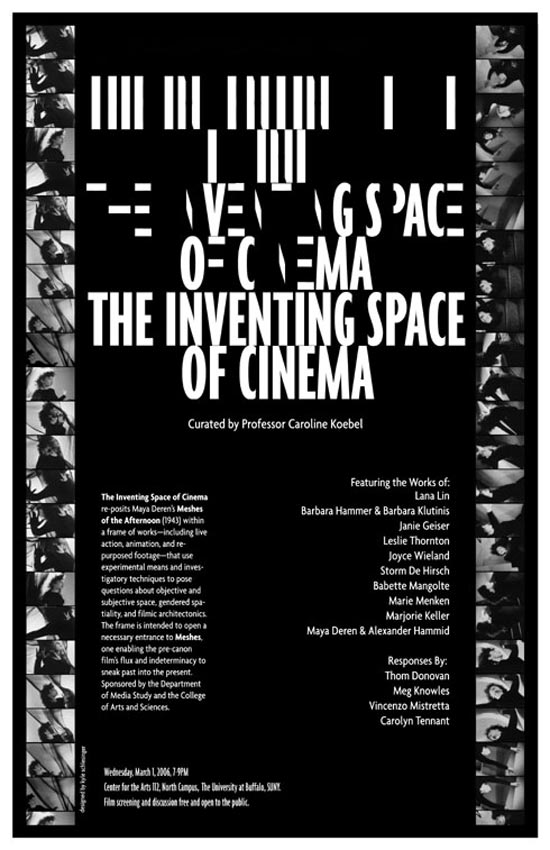
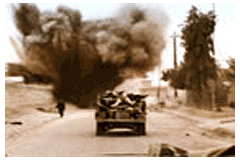
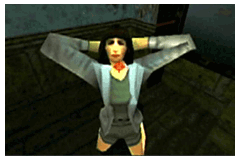
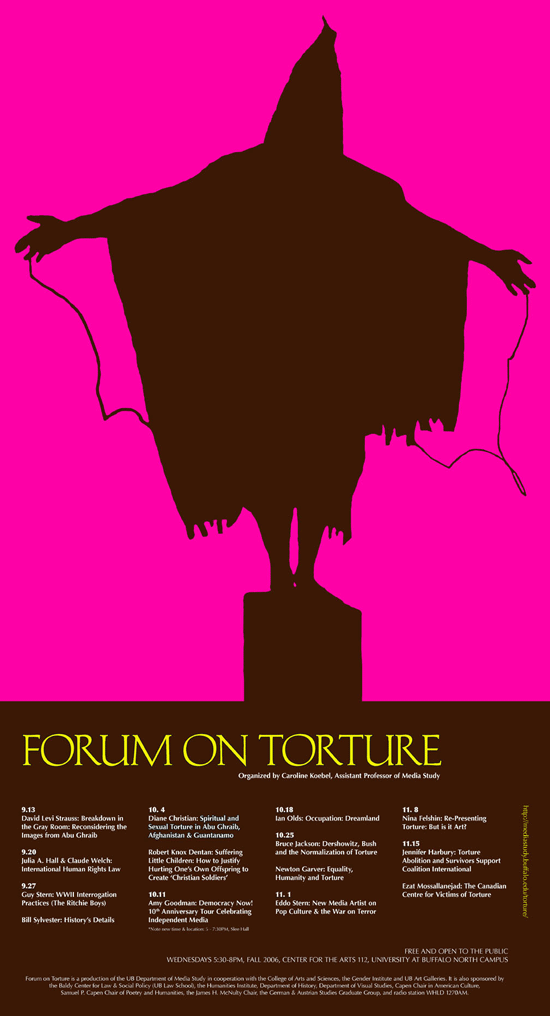
Weekly public forum, September 13 – November 15, 2006, at the University at Buffalo of lectures, screenings and discussions placing the Abu Ghraib human rights abuses within the larger social, cultural and political framework. Specific histories and events, from child abuse through WWII psychological warfare and CIA involvement in Central American “dirty wars” to computer games, were analyzed from such perspectives as International Law, the US Constitution, human rights advocacy campaigns, and visual theory. Films, artworks, and independent media expanding human rights discourse were presented by makers, curators, and journalists, with a special appearance on October 11th by Amy Goodman of Democracy Now!: The War and Peace Report.
Breakdown in the Gray Room: Reconsidering the Images from Abu Ghraib
Sept 20: Julia A. Hall & Claude Welch
International Human Rights Law
Sept 27: Guy Stern: WWII Interrogation Practices (The Ritchie Boys)
Bill Sylvester, Poet, UB English Professor Emeritus & WW II Vet
Oct 4: Diane Christian: Menstrual Blood as Torture Technology
Robert Knox Dentan: Suffering Little Children: How to Justify Hurting One's Own Offspring to Create 'Christian Soldiers'
Oct 11: Amy Goodman: Democracy Now!: The War & Peace Report
Oct 18: Ian Olds: Occupation: Dreamland
Oct 25: Bruce Jackson: Dershowitz, Bush and the Normalization of Torture
Newton Garver: Equality, Humanity and Torture
Nov 1: Eddo Stern: New Media Artist on Pop Culture & the War on Terror
Nov 8: Nina Felshin: Re-Presenting Torture: But is it Art?
Nov 15: Jennifer Harbury: Torture Abolition and Survivors Support Coalition International
Ezat Mossallanejad: The Canadian Centre for Victims of Torture
Full Program
Poster: Kyle Schlesinger
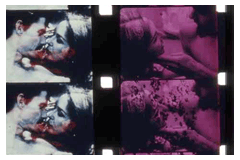
Images: Cool Hands and Warm Heart by Su Friedrich, Fuses by Carolee Schneemann
April Thursdays of Experimental Film
A month-long program in April 2007 at the University at Buffalo of short experimental films by female directors, including Barbara Hammer in person, a censorship v. freedom of expression debate about Carolee Schneemann’s Fuses, and compilation programs from The Film-Maker’s Cooperative in NYC and Canyon Cinema in San Francisco.
April 5: Barbara Hammer In Person: Endangered (1988, 18 min), Menses (1974, 4 min), Sanctus (1990, 19 min), Double Strength (1978, 14.5 min)
April 12: Face-Off: Porn, Erotica, Art film? Carolee Schneemann’s Fuses (1964-67, 22 min)
April 19: Gunvor Nelson and Su Friedrich (From Canyon Cinema): Schmeerguntz (GN & Dorothy Wiley, 1966, 15 min), Take Off (GN, 1972 10 min), Cool Hands and Warm Heart (SF, 17 min), Scar Tissue (SF, 1979, 7 min at 18 fps), Gently Down the Stream (SF, 1981, 14 min at 18fps)
April 26: Film-Makers' Cooperative program: Ritual in Transfigured Time (Maya Deren, 1946, 15 min), Go Go Go (Marie Menken, 1966, 12 min), Switch Center (Ericka Beckman, 2002, 10 min), Who Do You Think You Are (Mary Filippo, 1987, 10 min), Parcelle (Rose Lowder, 1979, 3 min.), Les Tournesols (Rose Lowder, 1982, 3 min), Black Coffee (Heather McAdams, 1985, 4 min), Fear of Blushing (Jennifer Reeves, 2001, 6 min), Angel Blue Sweet Wings (Chick Strand, 1966, 4 min), Superhero (Emily Breer, 1995, 6 min), Midweekend (Caroline Avery, 1985, 8 min), Egypt (Kathrin Resetarits, 1997, 10 min)
Ruth Goldman and Carolyn Tennant co-produced Barbara Hammer’s visit.

Poster: Kyle Schlesinger
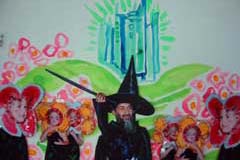
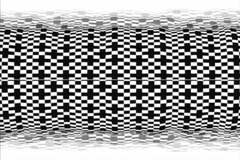
Images: Meet Me In Wichita by Martha Colburn, 1/3 (One Over Three) by Chiaki Watanabe
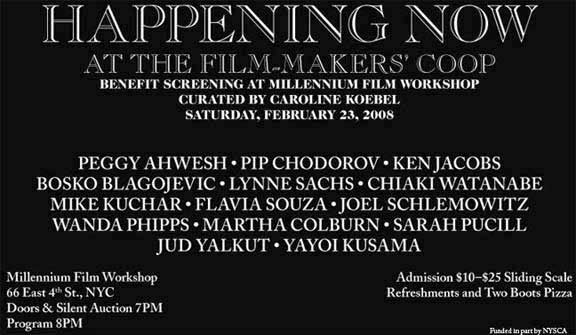
Happening Now at the Film-Makers’ Cooperative
Benefit Screening at Millennium Film Workshop, 66 East 4th St, NYC, Feb 23, 2008
Peggy Ahwesh: Beirut Outtakes (2007)
Pip Chodorov: Faux Mouvements (Wrong Moves) (2007)
Ken Jacobs: Capitalism: Slavery (2006)
Bosko Blagojevic: Description of A Struggle (2007)
Lynne Sachs: The Small Ones (2007)
Chiaki Watanabe: 1/3 (One Over Three) (2006)
Mike Kuchar: Tone Poem (1982)
Flavia Souza: Carnalevare (2003)
Joel Schlemowitz: The Glowing Woman (2007)
Martha Colburn: Meet Me In Wichita (2007)
Sarah Pucill: Backcomb (1995)
Jud Yalkut: Kusama's Self-Obliteration (1967/2007)
Curated by Caroline Koebel from works entered in the Coop in 2007. Since its founding in 1962, the Film-Makers’ Cooperative has played a vital role in the development of a truly independent, avant-garde cinema in the United States and abroad. It has been a model for other distribution organizations around the world. The Coop is open to all film/video makers regardless of style, subject matter, geography. Artists set the rental prices, write the descriptions for the catalog, receive equal treatment in regards to publicity, and care and handling of work. Come early, bring your friends, meet the makers, and see a wide range of cutting edge films and videos.
Poster: Kyle Schlesinger
Avant Cinema 3.6: Chick Strand Tribute
Curated by Caroline Koebel and Scott Stark for Austin Film Society
Feb 24, 2010, 7-9PM, Austin Studios Screening Room, 1901 E. 51st Street, Austin, Texas
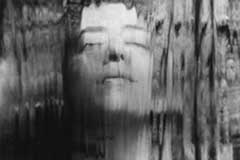
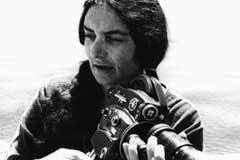
"Celebrated West Coast filmmaker Chick Strand (1931-2009) passed away this past summer, leaving behind a body of sensual and smart work significant for its exploration of the space between documentary and poetry, truth and fiction, and the politics and pleasure of representation. A key figure in the development of the American independent and avant-garde filmmaking movements, she helped co-found the seminal film exhibition and distribution collective Canyon Cinema in the mid-1960s. She began her own filmmaking career at the age of 34, combining a background in photographic collage and academic training in anthropology into a series of poetic documentaries shot in Mexico while an ethnography student at UCLA. ‘Ethnographic films’ Strand once wrote, ‘should be works of art, symphonies about the fabric of a people.’" - Amy Beste, School of the Art Institute of Chicago
Cosas De Mi Vida (1976) 16mm, color, sound, 25 min
Expressive documentary in an ethnographic approach about Anselmo, a Mexican Indian. It is a film about his struggle for survival in the Third World. Orphaned at age 7, he was the sole support of himself and his baby sister, who eventually starved and died in his arms. The film continues with Anselmo's struggle to live and to do something with his life other than a docile acceptance of poverty. Totally uneducated in a formal way, he taught himself how to play a horn and when he became a man he started his own street band. The film was started in 1965 and finished in 1975. During the 10 years, I saw the physical change in Anselmo's life in terms of things he could buy to make his family at first able to survive, and during the last years, to make them more comfortable. I felt a change in his spirit from a proud, individualistic and graceful man into one obsessed with possessions and role playing in order to get ahead and stay on top, but one cannot help but admire his energy and determination to succeed, to drag himself and his family out of the hopelessness and sameness of poverty to give them a future. Anselmo tells his own story in English although he does not speak the language. After he told me of his life in Spanish, I translated it into English and taught him how to say it. – Chick Strand, Film-Makers’ Cooperative catalog
Soft Fiction (1979) 16mm, black and white, sound, 55 min
"Chick Strand's Soft Fiction is a personal documentary that brilliantly portrays the survival power of female sensuality. It combines the documentary approach with a sensuous lyrical expressionism. Strand focuses her camera on people talking about their own experience, capturing subtle nuances in facial expressions and gestures that are rarely seen in cinema. The title Soft Fiction works on several levels. It evokes the soft line between truth and fiction that characterizes Strand's own approach to documentary, and suggests the idea of softcore fiction, which is appropriate to the film's erotic content and style. It's rare to find an erotic film with a female perspective dominating both the narrative discourse and the visual and audio rhythms with which the film is structured. Strand continues to celebrate in her brilliant, innovative personal documentaries her theme, the reaffirmation of the tough resilience of the human spirit."
– Marsha Kinder, Film Quarterly, reprinted in Film-Makers’ Cooperative catalog
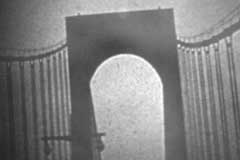
Images: Commingled Containers by Stan Brakhage, Bridges-Go-Round by Shirley Clarke
Avant Cinema 3.7: Film-Makers’ Cooperative
Programmed by Caroline Koebel and Scott Stark for Austin Film Society
Mar 31, 2010, 7-9PM, Austin Studios Screening Room, 1901 E. 51st Street, Austin, Texas
Avant Cinema: Film-Makers' Cooperative brings from New York City to Austin the group-curated program A Moveable Feast, originally presented at the Howl! Arts Festival. Coop board members selected titles from the collection most influential on their own filmmaking. The program is also a celebration of the Coop’s move to its new home at 475 Park Avenue South.
The Film-Makers' Cooperative is the largest archive and distributor of independent and avant-garde films in the world. Created by artists in 1962 as the distribution branch of the New American Cinema Group, the Coop has more than 5,000 films, videotapes and DVDs in its collection.
“We don't want false, polished, slick films—we prefer them rough, unpolished, but alive; we don't want rosy films—we want them the color of blood.” – The First Statement of the New American Cinema Group, September 30, 1962
Viet-Flakes - Carolee Schneemann, 1966 16mm, B/W, sound, 11 min
Selected by M.M. Serra
Viet-Flakes was composed from an obsessive collection of Vietnam atrocity images I collected from foreign magazines and newspapers over a five-year period. Magnifying glasses from the "5 & 10" were taped onto a borrowed 16mm Bolex in order to physically "travel" within the photographs - producing a rough animation. Images in and out of focus, broken rhythms and pans, the abstracted shapes and motions, speeding perceptual contradictions. For instance, a pointillism of falling black specks in focus becomes bombs dropping through the sky; an impressionistic swirl of tones translates as faces of US soldiers leading barefoot villagers from a gas-filled tunnel; a "Rembrandt ink drawing" focuses in as a tank dragging a roped body .... Viet-Flakes was central in "Snows," the Kinetic Theater work I presented at the Martinique Theater, New York, 1966, in conjunction with Angry Arts Week. "Snows" concretized imagery and the denied ravages of the war and did its part in heightening moral outrage at the endless destruction. James Tenney's sound collage intercuts three-second fragments of Vietnamese religious chants and secular songs with fragments of Bach and 1960s "Top of the Charts."
Fragments - Mike Kuchar, 1967 16mm, color, sound, 10 min
Selected by Jack Waters
A visual drift into the realm of electric colors, sensual curves and dark, dank grasslands, where one is lost with himself.
Angel Blue Sweet Wings - Chick Strand, 1966 16mm, color, sound, 4 min
Selected by Lynne Sachs
An experimental film poem in celebration of life and visions. Techniques include live action, animation, montage and found images. Exhibition: New York Film Festival; Arles, France Film Festival; Canadian Women's Film Festival.
Bridges-Go-Round - Shirley Clarke, 1958 16mm, color, sound, 7 min
Selected by Donna Cameron
"By my standards, Miss Clarke's picture, an eerie close-up of the metropolitan bridges, is extraordinary. A film that captures the bizarre magic of man-made spans with the movement of a lightning clap and with the same terrible beauty." -- Howard Thompson, The New York Times "A new creative development ... truly excellent." – Mr. Hugh Gray, Dept. of Film, UCLA
Scotch Tape - Jack Smith, 1962 16mm, color, sound, 3 min
Selected by Anne Hanavan
With Jerry Sims, Ken Jacobs and Reese Haire. 16mm Kodachrome shot on the rubble strewn site of the future Lincoln Center. The title arises from the piece of scotch tape which had become wedged in the camera gate.
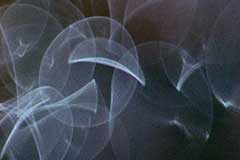
Commingled Containers - Stan Brakhage 1996 16mm, color, silent, 3 min
Selected by Scott Nyerges
The film begins with anamorphic lens vision of water, prismatically etched dark blue needles of watery turbulence shifting radically in sudden twists of the anamorphic lens. . . a sense of a violently roughened surface to a stream which cuts to a darkened quietude of gently evolving under-water bubbles, pulsing like living entities. The entire film juxtaposes its water surface tensions and its under-water pulsing forms of light, its blues of water surface reflecting sky, and whites of watery turbulence, and its sub surface world of quiet whites yellows and oranges, ending finally on a surface shot which resolves these tones.
Cartoon Le Mousse - Chick Strand, 1979 16mm, color, sound, 12 min
Selected by Bradley Eros
"Chick Strand is a prolific and prodigiously gifted film artist who seems to break new ground with each new work. Her recent "found footage" works such as Cartoon Le Mousse, are extraordinarily beautiful, moving, visionary pieces that push this genre into previously unexplored territory. If poetry is the art of making evocative connections between otherwise dissimilar phenomena, then Chick Strand is a great poet, for these films transcend their material to create a surreal and sublime universe beyond reason." – Gene Youngblood
The Whirled - Ken Jacobs, 1961 16mm, color & B/W, sound, 4 min
Selected by Colen Fitzgibbon
The Following four films are early images of Jack Smith:1. Saturday Afternoon Blood Sacrifice (1956)2. Little Cobra Dance (1956)3. Hunch Your Back (1963) 4. Death of P'Town (1961) The first two shorts were shot around Jack's loft on Reade Street on two 100' rolls (Sunday morning, following Saturday's sacrifice, I saw there was another 50' left) in an impromptu way very different from my initial fastidious art-film approach. I would never be an art-film true-believer again. In 1963 a snatch of "Saturday Afternoon..." was shown on TV when I was somehow invited to participate in a TV quiz program called Hunch Your Back ("Back Your Hunch"). After years of shooting my raging epic "Star Spangled to Death" starring Jack as The Spirit Not of Life But of Living, and after a few months of being on the outs with each other, we got together for one last stab at friendship and the making of a film in Provincetown, Summer of '61. – Ken Jacobs "Mountaineer Spinning" is not for persons afflicted with epilepsy. Music by Rick Reed, best played loud (but not uncomfortable) through two pairs of stereo speakers placed front and rear: "virtual surround" is perfect.
Ceci N'est Pas - Jeanne Liotta, 1997 16mm, B/W, sound, 7 min
Selected by Ghen Zando-Dennis
Hand-developed and unedited, this roll lived in my camera from March to May 1995: A trip to New Orleans, a train ride, the death of a dear friend and artist. This film is the author of itself; its trace function leaves me behind. "The cadaverous presence establishes a relation between here and nowhere." – Maurice Blanchot. "The Phantome disturbs by its just out of reach presence." – Bruce Witsiepe
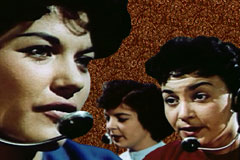
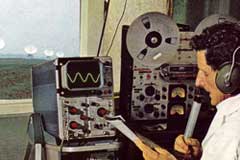
Kelly Sears: Filmmaker in Person
Programmed by Caroline Koebel for Experimental Response Cinema
May 23, 2012, 7:30-9PM, 29th Street Ballroom at Spiderhouse, Austin, Texas
Experimental Response Cinema and 29th Street Ballroom host Galveston-based animator and filmmaker KELLY SEARS, whose internationally-exhibited collage films are culled from discarded periodicals, books, archives, and orphan cinema. Drawing on experimental, documentary and narrative practices and featuring both analog and digital animation techniques, her films harness images of the past to reflect on the present. She is a current resident at the Galveston Artist Residency and a 2009-2011 fellow at the Core Program at the Museum of Fine Arts, Houston. Her films have screened widely, including at the Los Angeles County Museum of Art, Ann Arbor Film Fest, San Francisco Museum of Modern Art, Sundance, and Anthology Film Archives. The approximately one-hour program will be followed by a Q & A moderated by Caroline Koebel with Kelly Sears. http://www.kellysears.com/
Films include: Once It Started It Could Not End Otherwise, Imprinted, Cover Me Alpha, Voice on the Line, The Body Besieged, Jean, The Believers, He Hates to be Second, The Drift, Angels Chant Like Witches, Devil's Canyon, and Charles and Christopher.
Experimental Response Cinema is an Austin-based collective of avant-garde film and video artists, devoted to bringing local, national and international experimental films to Austin screens.
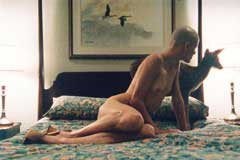
The Friendship State: Texas Experimental Filmmakers
The program embraces the dialog between makers and comprises five artists, including me, from diverse points of Texas: Lyndsay Bloom, Caroline Koebel, Jennifer Lane, Kelly Sears, and Scott Stark. Program Details
Peras de Olmo – Ars Continua, Sep 28, 2013, Buenos Aires, Argentina
CineMarfa, May 5, 2013, Marfa, Texas
Zeitgeist Multi-Disciplinary Arts Center, Apr 27, 2013, New Orleans, Louisiana
Austin Film Society, Feb 22, 2013, Austin, Texas
Microscope Gallery, Nov 5, 2012, Brooklyn, New York
Kino B: Contemporary Cinema by Berlin-based Artists
Commissioned by Aurora Picture Show, Kino B initiates viewers into the swarm of moving images made thus far in the 2010s by Berlin-based artists. Sylvia Schedelbauer's SOUNDING GLASS, the stunning and astounding experimental short about vision, history, memory, and war that won accolades at Ann Arbor and Oberhausen, centers the outwardly spiraling program. The other projects—curated in situ during a research trip to Berlin—include film, video and installation (transposed to single-channel projection) by Guillaume Cailleau & Ben Russell, Harun Farocki, Isabella Gresser, Bernd Lützeler, Anna Marziano, Deborah S. Phillips, Michael Poetschko, and Daniel Steegmann Mangrané. Chosen for their individual merits and seemingly unrelated in their disparateness, the works nonetheless share a command of cinema's potential for experientially transformative critical reflection. Each title, in its own way, acts as an experimental essay on the world as it can be encountered, engaged and repositioned so as to enable a dialogue between self (artist) and others (viewers) on that world. Program Details
Aurora Picture Show, Oct 19, 2013, Houston Texas